Bank of South Carolina Q3 Earnings Analysis: 12.97% Profit Rise
Bank of South Carolina earned $2.42 million in the third quarter, up 12.97%, as net interest margin widened to 4.85% and return on average equity hit 15.49%.
The news
The Bank of South Carolina Corporation (OTCQX: BKSC) reported unaudited third-quarter earnings of $2,421,687, or $0.45 basic and $0.44 diluted per share. That is up $278,047, or 12.97%, from $2,143,640 a year earlier. For the nine months, earnings rose 14.55% to $6,751,539 from $5,893,809. Annualized return on average assets for the quarter was 1.71% against 1.46%, and return on average equity was 15.49% against 14.58%.
President and CEO Eugene H. Walpole IV attributed the results to a net interest margin of 4.85%, and said the Charleston-based bank sees steady loan demand in its local markets, a solid capital position and low past-due levels.
Our analysis
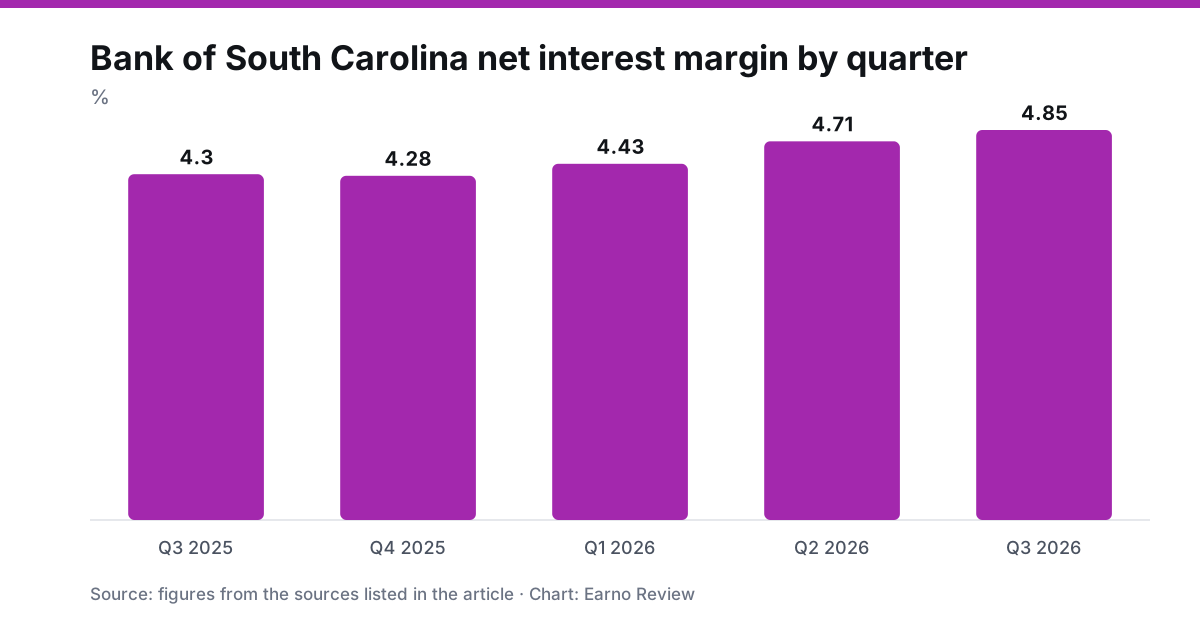
This earnings analysis turns on the margin. Net interest income was $6.58 million, up 9.4% from $6.01 million a year ago, while total interest and fee income was almost flat ($7.47 million against $7.32 million). The gain came from the cost of funds: interest expense fell to $0.89 million from $1.30 million. Net interest margin has widened in each of the last three quarters.
| Quarter | Net interest margin |
|---|---|
| Sept. 30, 2025 | 4.30% |
| Dec. 31, 2025 | 4.28% |
| Mar. 31, 2026 | 4.43% |
| June 30, 2026 | 4.71% |
| Sept. 30, 2026 | 4.85% |
Earnings also rose 4.4% from the second quarter’s $2,318,933, and returns improved on a nine-month basis too: return on average assets was 1.60% against 1.37%, and return on average equity was 14.69% against 14.03%.
Other lines were stable. Total other expense was $3.74 million, up 6.4% from $3.52 million, and the efficiency ratio was 53.20% compared with 53.82%. Provision for credit losses was $150,000 against $250,000 a year ago. The allowance for credit losses stood at 1.21% of loans compared with 1.16%. Loans past due 30 days were 0.28% of loans, down from 0.98% in June but above the 0.21% of a year ago. The community bank leverage ratio was 11.93%.
The balance sheet shrank slightly: average assets were $562.0 million versus $580.8 million, and average deposits $485.7 million versus $506.8 million. Average loans edged up to $371.8 million from $360.1 million. Shares outstanding fell to 5,338,872 from 5,420,099, which helped per-share results modestly.
For a bank of this size, the margin is the main earnings lever. Annualized return on average assets of 1.71% is high by community bank standards, and the 53.20% efficiency ratio means about 53 cents of expense for each dollar of revenue. Shares outstanding have fallen over the past year, from 5,420,099 to 5,338,872, a reduction of about 1.5%, though the count was unchanged from June.
Room for disagreement
Margin expansion driven by lower deposit costs has a limit, and the bank earned the improvement while its deposits and assets shrank. Past-due loans, while low, rose from the third quarter of last year, and income tax expense of $717,953 was higher than last year’s $623,319, which means pre-tax growth was 13.5% against after-tax growth of 13%. Book value per share also slipped to $11.32 from $11.43 in June.
What to watch
The release does not include formal earnings guidance. Watch whether net interest margin holds near 4.85% when deposit costs stop falling, how deposits behave after the decline, and whether the steady loan demand the CEO described in the bank’s local markets turns into faster loan growth. The fourth-quarter report will round out the year.
Prepared with AI assistance from public sources and reviewed under our editorial policy. Not investment advice.